

Got questions? Browse through our online help for pet owners and those aspiring to become one, and look at our frequently asked questions below!
Please remember:
This page provides access to SPCA vet-approved resources and links on pet home care and first aid for those times you cannot get to a vet. This information does not replace a vet, and we urge you to seek assistance from a qualified vet - get in touch with us!
Free Guides to Read Online or Download
-

Our SPCA Care Animal Guide
Browse our comprehensive guide with tips and information on caring for animals.
-

General Care for Puppies and Adult Dogs
Basic tips on caring for your new furry friend!
-

Cat and Kitten Care Basics Guide
Basic tips on caring for your new furry friend!
Animal First Aid Basics
Accidents happen despite our best efforts. Practice Prevention should become second nature – for you, your family and your animals.

Frequently Asked Questions
-
Despite our limited resources and space, we try the best we can to help as many animals as possible. If you spotted and injured animal, please get in touch with us.
If you are able to help the animal immediately, please offer some water and/or move it out of a danger zone (e.g. from a road). If you are unsure, or the dog/cat is severely hurt, it may be better not to move it as you may shift bones and make it worse.
If we are notified, we try our best to pick up the animal and provide the necessary care.
-
We are grateful to anyone helping animals. If you find an injured dog or cat, it's best to contact us first before bringing it in, as our shelter may be full.
However, if you can't reach us or it's an emergency, please bring the dog or cat to us. or if possible, move the animal to a safe location where you can provide shelter, food, and water. It's crucial to ensure injured animals receive medical attention, as many injuries and diseases cannot be treated with home remedies.
-
No one is required to keep a pet they've found if they can't or simply do not want to. If you see a suffering stray but are unsure how to help, it is always a good idea to approach the animal and offer water.
Please remember, stray dogs have no one to speak for them, so you might be its only chance! If you are unsure how to help, please get in touch with us via a call or email, and we try and figure something out!
-
Congratulations on deciding to share your life with a puppy!
Whether you found your puppy or received it from a friend or neighbor, there are important steps to ensure its survival, especially during its young age.
First, prepare a designated area with a dry bed, blanket or towel, and always provide fresh water. Get in touch with us to organise to deworm and deflea your puppy, and feed it protein-rich food twice a day. You should also vaccinate your puppy against parvovirus, a common and often fatal virus in Fiji. If you bring your puppy to us, our vet can perform a check-up, administer vaccines, and offer tips to keep your puppy healthy and happy.
-
Desexing is the single most important thing to do in Fiji to combat the terrible situation of thousands of malnourished, suffering, and mistreated stray animals.
Desexing, or neutering, involves removing an animal's ability to reproduce. It helps prevent overpopulation, reducing the number of abandoned or shelter-bound dogs here in Fiji.
Did you know that one pair of fertile dogs can produce 16 puppies in one year?
As all of these puppies grow up and have their own puppies, this will lead to over 12,000 puppies in 5 years, all direct descendants of the original mating pair.
Desexing also lowers the risk of certain health problems, such as tumours and infections, and can decrease behavioural issues like aggression and territory marking. Overall, desexing promotes the health and well-being of pets while helping manage the number of stray and unwanted animals.
-
Generally speaking, desexing is a common and safe procedure performed thousands of times every single day.
Many false rumours should not deter you from desexing your pet. This process offers several benefits: your cat or dog will not go into heat or seek mates to reproduce. Females will generally be left alone by males. Pregnancy is hard on a female's body, so desexing allows her to enjoy life without this strain.
-
In female dogs and cats, a small incision is made in the abdomen from which the uterus and ovaries are removed. This is a permanent solution, and desexed female dogs will never come into season or have puppies again.
In male dogs and cats, it is a less invasive procedure where both testicles are removed from a small incision near the scrotum.
All animals are under general anaesthesia for these procedures and are also given extra pain relief to prevent any post-operative discomfort.
-
When adopting a pet, consider several key factors:
First, evaluate the pet's needs and how they align with your lifestyle, including your time, space, and financial resources.
Ensure you can provide proper care, such as feeding, exercise, and medical attention. Think about how a pet will impact your daily routine and whether your living situation is suitable.
Lastly, be prepared for the commitment, as pets require long-term care and attention.
-
We generally charge $60 - $90 FJD for dogs, depending on their size and weight. Female cats cost $45 FJD, and male cats cost $25 FJD.
-
No, it is never ok to hit an animal.
If you are trying to teach your dog certain behaviours, do not hit him or her for punishment. Instead, try to reward positive behaviours. If your dog does what you want him/her to do, offer a little treat. This way, your dog will associate the right behaviour with a reward and will learn this way.
Hitting a dog is never ok!
-
Unfortunately, animal protection laws aren't properly enforced in Fiji. Despite rampant animal cruelty cases, we do not know of a single prosecuted case.
If you witness animal cruelty, it is important to speak out immediately and confront the person(s).
Remember that the animal - whether owned or stray - may not have anyone else intervening on its behalf. Please make the person(s) aware that it is not ok to be cruel to animals, which are sentient beings just like us. In severe cases, please also report the cruelty to the police.
If more people report animal cruelty, these crimes will eventually be properly prosecuted like other cases. If no one ever reports it, there will be no change, so let's join together and give a voice to the voiceless.
If you want to read the Protection of Animals Act, click here.
-
We always need more fosters who are able to take in and care for pets! We have some fosters who specialize in pets recovering from illness or injury. Others open their homes temporarily to puppies, kittens, dogs, cats, and even other pets.
You can foster for as little as a weekend or over a holiday, for several weeks, or for longer periods.
Whilewe are very grateful for all our fosters, please understand that we need to ask a few basic questions to assess whether your home is suitable for the animal(s) you like to look after.
-
Yes, and we need you!
We have dozens of volunteers from all walks of life every year.
Even if you can give just an hour a week, you could take one of our dogs out on a walk—this may not seem much, but it could mean the world to the dog! If you have any other talents or ideas on how to assist us, please reach out!
We created a form for our interested volunteers - fill it out, and we look forward to meeting you!
-
The Trap, Neuter, Release (TNR) program is an effective strategy for managing Fiji's stray dog population.
For this initiative we work together with the Ministry of Agriculture and the local Town Councils. Dogs that were either trapped or brought to us are neutered or spayed to prevent further breeding, and finally released back into their original environment.
Our TNR program helps control the population of stray dogs without resorting to euthanasia, reducing the number of unwanted puppies and improving the overall health of the dog community.
If you know of stray (or owned) dogs in your neighbourhood that need desexing - please get in touch, and we may be able to help you by catching the dog and/or speaking to the respective owners.
-
The Community Partner Program (CPR) primarily involves local community members who take responsibility for stray or overpopulated dogs in their area.
If someone is feeding or caring for a stray dog or dealing with too many dogs on their street, we assist by providing necessary care such as desexing, deworming, and defleaing, depending on available donations. We may also offer transport support. So please reach out and help us help animals!
We encourage donations to this program (please make sure to add CPR in the reference section) to ensure we can continue helping more people care for these animals and maintain the well-being of the community.
-
When a dog is losing its fur, it is often caused by an easy-to-treat skin infection called mange.
Mange is a skin disease in dogs caused by parasitic mites, leading to intense itching, hair loss, and skin inflammation. Two common types of mange, sarcoptic and demodectic, can cause significant discomfort and secondary infections if left untreated.
Sarcoptic mange is highly contagious, while demodectic mange typically affects dogs with weakened immune systems. Simparica, an oral medication, has proven to be an effective treatment for mange. It targets and eliminates the mites responsible for the disease, providing relief from symptoms and promoting skin healing.
Mange is treatable, and please don’t just dump your dog or give up on a stray in your neighbourhood. Contact us, and we will try to help!
-
Vet Essentials
Address: Humes St, Wailada Rd, Lami Phone: 906 1653 Email: vetessentials.fiji@gmail.com Facebook: www.facebook.com/vetessentials.fiji
Go Vet Clinic
Address: Mead Road, Namadi Phone: 939 7319 Email: Sales@govetfiji.comFacebook: www.facebook.com/govetclinicfiji
-
A cough in a dog can indicate a variety of conditions, ranging from mild to serious.
Please give us a call and/or consult with a veterinarian as soon as possible.
There are no home remedies for some of the below-listed serious conditions!
Some common causes include:
Kennel Cough: A highly contagious respiratory infection that causes a dry, hacking cough, often contracted in places where many dogs are present, such as kennels or shelters.
Heart Disease: Conditions like congestive heart failure can cause a persistent cough, particularly at night or after exercise, due to fluid buildup in the lungs.
Tracheal Collapse: Especially common in small breeds, this condition occurs when the trachea partially collapses, leading to a honking cough.
Respiratory Infections: Bacterial or viral infections, such as canine influenza or pneumonia, can cause coughing along with other symptoms like fever and lethargy.
Allergies: Environmental allergies can cause coughing due to irritation of the airways, along with other signs like sneezing and itching.
Heartworm Disease: Infected dogs may develop a cough as the heartworms grow and begin to affect the lungs and heart.
Foreign Object: If a dog inhales a foreign object, it can become lodged in the airway, causing coughing as the body attempts to expel it.
Chronic Bronchitis: This condition causes long-term inflammation of the airways, leading to a chronic cough that can worsen over time.
If your dog is coughing persistently or showing other symptoms, it's important to consult a veterinarian to determine the underlying cause and receive appropriate treatment.
-
The short answer is yes!
For detailed information on caring for your cat or kitten, download Health Care for Kittens and Cats which you will find on this page if you scroll towards the top.
It is important to protect your kittens and cats against the three most common serious diseases:
Feline Viral Rhinotracheitis
Feline Calicivirus and
Feline Panleukopenia.
For your kitten and cat to be fully protected against these diseases, they will require a primary course of 3 vaccines. This ensures good immunity from disease. This means after your kitten has received their first vaccine, they must return in 1 month for their booster and one month later for their second booster. This will provide protection to them for one year, and it is important to get your pet their booster yearly in order to maintain their immunity.
If possible, your kitten should be kept away from unvaccinated cats and kittens who are not siblings and areas where unvaccinated cats could have been until two weeks after their final vaccination.
Additional vaccines are sometimes considered and include the Feline Leukemia Virus – these should be discussed with your veterinarian.
-
Yes, absolutely. For dogs (and cats), we recommend a primary course of 3 vaccines. This ensures good immunity from disease. This means after your puppy has received their first vaccine, the must return in 1 month for their booster and one month later for their second booster. This will provide protection to them for one year, and it is important to get your pet their booster yearly in order to maintain their immunity. It is best to begin vaccination when your puppy is 8 weeks old, but any animals older than that can come in to start their vaccines also. It is important to protect your adult pets too!
The common vaccines for dogs include vaccinating for:
Parvo-virus, which can cause fatal vomiting and diarrhoea and is highly contagious
Distemper, which affects the lungs, gut and brain
Adenovirus, which causes severe infection of the liver
Parainfluenza virus, which causes a cold-like illness and coughing and is extremely contagious
Leptospirosis, a bacteria which affects the liver and kidneys and is often fatal. It is very prevalent in certain areas of Fiji.
-
Poisoning is an extremely common cause of death of animals in Fiji.
While many people are aware of the dangers of poisoning from substances such as Paraquat and Rat Poison, not many people are aware of the items in your house which can make your animal very sick. Dogs are generally more susceptible to poisoning than cats, but it is important to remain cautious for all pets.
Onions and Garlic
While these may be everyday ingredients for dinner for many of us, onion and garlic can have severe effects on our pets. It causes anaemia which may require a blood transfusion if severe.
Grapes
Grapes can cause sudden and severe kidney failure in cats and dogs. Remember, sultanas and raisins are just as poisonous!
Chocolate
Chocolate poisoning is common in dogs due to them enjoying the sweet taste but can have serious consequences such as vomiting, muscle tremors and even seizures. Darker chocolate is more dangerous, and smaller amounts can be more serious.
Drugs and Alcohol
Common drugs you may stock, such as aspirin and paracetamol, can be dangerous in dogs and cats, causing stomach ulcers and kidney failure.
Alcohol causes a drop in blood pressure and temperature and can result in seizures and death.
Lillies
These beautiful flowers are extremely toxic to cats. If you are a cat owner, it is recommended that you do not have Lillies in your house as the pollen, leaves, and stems are all extremely toxic to cats causing kidney failure and death.
If you suspect that your animal has been poisoned or eaten one of these substances mentioned, please contact your vet as soon as possible. If your animal sees the vet immediately, we can administer life-saving treatment, sometimes before any poison has even been absorbed. Remember, time is of the essence!
-
We all know what we need to do to prepare for a cyclone. But have you included your house pet and your other domestic animals in your preparations?
Here are some things you can consider to give the animals in your care the best chance possible in a disaster.
If you can, bring the dogs and cats indoors. If you cannot do this, unchain them and make sure there is at least some shelter they can hide out in.
Store their food and water and have some boxes or newspapers ready for their toilet (you can put these in the bathroom). Keep some plastic or rubbish bags handy.
If you have cages, when the cyclone is closer, place your pets safely inside the cages so if you have to move, you can do it quickly. During the height of the cyclone, you can help your pet feel safer by covering the cage with a towel or blanket.
Consider your options now - if you have to move to an evacuation centre (where animals are not catered for), are you prepared to leave your pets behind? If not, what options might be available to you?
If you do have to move to an evacuation centre, and there is no one around to look after your pets, let them out and leave food.
For large animals such as cows and horses, if you can, move them to higher ground away from fast-flowing flooding zones. Do this well before the cyclone arrives and follow all National Disaster Office and government advice.
Before the cyclone hits, untie the horses or cows - this gives them a chance to find their own safe spot.
After the cyclone, put out food and water and call the animals - they may not return immediately, but they generally will come out when they feel safe. Just keep making your presence known and put food out.
If you and your family are ok after the cyclone, help others. Look out for wandering animals and secure and feed them if you can. You will be doing another person - and the animal - a service. Cows and horses are people's livelihoods. The return of a beloved dog, cat, cow and even poultry can be an emotional support for people who are dealing with the trauma of the cyclone and loss of home and possessions.
-
The short answer is yes, sometimes we do have to euthanise animals.
When an owner and veterinarian agree that a pet is suffering with no hope of recovery, euthanasia offers a humane way to end the pet's pain. It's a difficult decision for both parties, but it may be the kindest choice.
Understanding the procedure can help an owner decide whether to be present during euthanasia. Pets are made as comfortable as possible, sometimes in their own home, or in a quiet room at the veterinary hospital. A mild sedative may be given to ease anxiety or pain, and having the owner present can be comforting for the pet.
Euthanasia may also be necessary for stray or surrendered animals, especially those with severe injuries or contagious diseases. After a medical review, the vet may determine that euthanasia is the most humane option, particularly if the shelter is at capacity or if the animal is too ill or aggressive.
Euthanizing any animal is never easy, but sometimes it’s the only way to prevent further suffering. Not only us, but shelters worldwide face these tough decisions due to the ongoing issue of abandoned and unneutered pets.
We encourage rescuers to explore other options before surrendering an animal to a shelter. If the animal is healthy, consider finding a new home with family or friends, or fostering the animal yourself.
Surrendering should be a last resort, as once the animal is handed over, no further updates or explanations will be provided about its fate.
A few facts about mange, a common disease among strays in Fiji.
When a dog is losing its fur, it is often caused by an easy-to-treat skin infection called mange.
Mange is a skin disease in dogs caused by parasitic mites, leading to intense itching, hair loss, and skin inflammation. Two common types of mange, sarcoptic and demodectic, can cause significant discomfort and secondary infections if left untreated.
Sarcoptic mange is highly contagious, while demodectic mange typically affects dogs with weakened immune systems. Simparica, an oral medication, has proven to be an effective treatment for mange. It targets and eliminates the mites responsible for the disease, providing relief from symptoms and promoting skin healing.
Simparica's ease of administration and efficacy make it a preferred choice for veterinarians and pet owners, facilitating quick and straightforward treatment of mange in dogs.
Mange is treatable, and please don’t just dump your dog or give up on a stray in your neighbourhood. Contact us, and we will try to help!
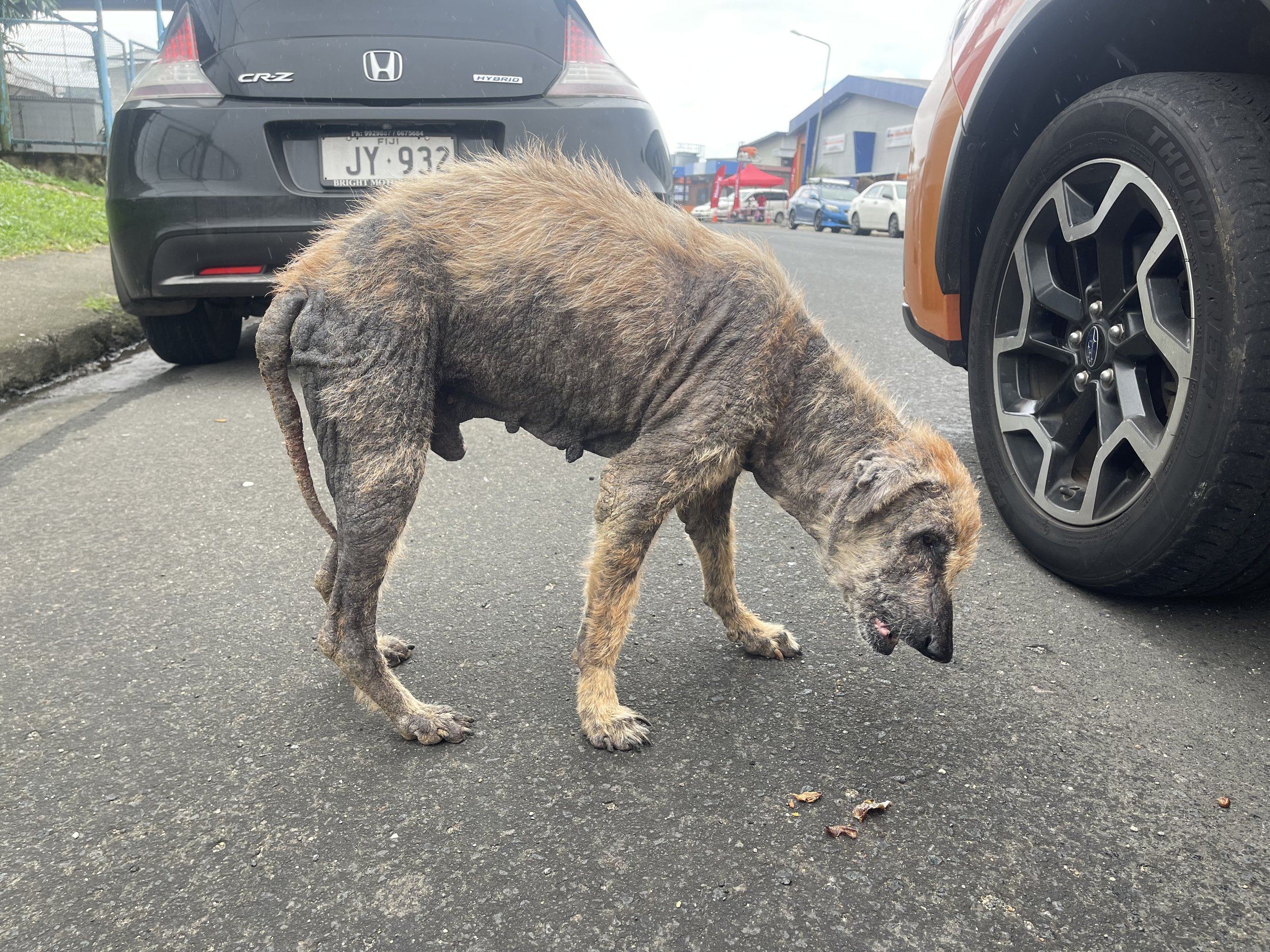

Simba was picked up on the road with severe mange. After the right medication, Simba’s fur has completely grown back after three months.

Haven’t found what you are looking for?
Fill out the contact form, get in touch with us via email spca@connect.com.fj, or give us a call!
Be Prepared! Make up a Pet First-Aid Kit
Emergencies can strike at any time, whether you are safely at home or driving to work. A vet may not always be available so a first aid kit can come in useful. Here is a list of items to keep on hand at all times. We suggest keeping one set in your car and one at home.
Your nearest vet phone number (SPCA is 9980023 or 3301266. After-hours emergency number is 9922364).
Tarp or heavy blanket (to use as a stretcher)
Blanket or towel (to cover the injured animal).
Waterproof sheet or tarpaulin (for cover from the elements).
Hand towels (for applying pressure to bleeding wound)
Pads of clean cloth or gauze (for placing over cleaned wounds)
Rolled bandage material or long strips of cloth (for keeping wound pads in place)
Honey or antibiotic ointment (for small wounds)
A saline (saltwater) solution (for washing out wounds)
Clean water (bottled water or boiled cooled water)
Hydrogen peroxide (small amounts to trigger vomiting)
Milk of Magnesia or charcoal slurry (to absorb poisons or toxins)
Antihistamine for allergic reactions
Pet First Aid booklet to give detailed instructions on when and how to use these items.
Other items you should have ready for any disaster include:
leash and secure carrier or box for smaller animals and cats;
food and water (enough for one week at least);
waterproof plastic sheet;
food and water bowls;
your pet's medications;
liquid soap or shampoo.
Don't leave it to the last minute! Make your preparations now.